Winter shouldn’t shut down your outdoor space. But if the deck, courtyard, or dining terrace starts to get chilly during winter months or when the sun goes down, chances are the outdoor heater doesn’t match the space, or there isn’t one at all.
A heater that doesn’t suit the site can leave you with cold spots, high running costs, or clashes with an Opening Roof. The fix starts with understanding the different types of outdoor heaters: gas, electric, open-flame, and how each one mounts. Get the type right from the start, and the space works through every season, not just the warm ones. Plus, we will recommend our Outdoor Heater of choice for your Louvretec Outdoor Room.
Keep reading to see how they compare and design the perfect outdoor room!
Outdoor Heater Types at a Glance
Patio Heaters: Fuel Type
| Type | How It Works | Best For | Keep in Mind |
|---|---|---|---|
| Propane | Runs on a refillable gas bottle | Portable spaces with no fixed gas line | Bottle needs regular refilling or swapping |
| Natural gas | Connects directly to the home or venue's gas line | Permanent, frequently used dining or alfresco areas | Needs a licensed gas fitter, stays fixed in place |
| Electric | Plugs into a power point or dedicated circuit. Louvretec recommends Bromic Platinum and Eclipse Electric Heaters. | Closed-in spaces, particularly under an Opening Roof outdoor living space. | - |
Patio Heaters: Mounting Style
| Type | How It Works | Best For | Keep in Mind |
|---|---|---|---|
| Freestanding | Stands on its own base, fully portable | Flexible layouts, rentals, spaces still being planned | Need a flat, even floor space. |
| Wall-mounted | Fixed to a wall or post | Frees up floor space, pairs well with glass infill | Position is fixed once installed |
| Ceiling-mounted | Fixed to the underside of a roof or eave | Louvretec Room setups, zero floor or wall footprint | Needs a roof structure already in place to mount to |
Open-Flame Options
| Type | How It Works | Best For | Keep in Mind |
|---|---|---|---|
| Fire pit | Open basin, radiates heat a full 360° | Open-air group gatherings and social settings | Needs open sky, not suited to a covered or glazed space |
| Chiminea | Enclosed body, directs heat and smoke one way | Small courtyards and intimate, one-on-one settings | Wood-burning, also needs open air above it |
How Do Patio Heaters Differ from Fire Pits and Chimineas?
Patio heaters, fire pits, and chimineas all produce outdoor heat, but they work in different ways and suit different settings.
Patio Heaters
These can either be gas or electric and produce controlled, directional warmth with little to no smoke. They’re built for repeat use with minimal fuss, making them the practical choice under an opening roof or anywhere smoke isn’t welcome.
Fire Pits
These open basins throw heat out in every direction and work well as a gathering point, with most suiting a bigger group than a chiminea does. They run on wood, gas, or smokeless fuel, but the open flame needs clear airflow above and around it, which rules out anywhere with a closed roof or glass sides.
Chimineas
These are enclosed clay or metal fireplaces with a single opening, directing heat and smoke mostly in one direction. That makes a chiminea better suited to a small courtyard seating a couple of people than a full outdoor entertaining area, and like fire pits, it needs open air above it to draw properly.
If the space you're heating has a roof, sides, or both, patio heaters are the only one of the three built for it. Fire pits and chimineas need open sky.
What’s the Difference Between Propane, Natural Gas, and Electric Outdoor Heaters?
Choosing the best fuel to run your patio heater depends on how much heat you need and where you want to run it.
Propane Heaters
These run on a refillable gas bottle, so there's no need for a fixed gas line. That makes propane heaters one of the most portable options; you can move the heater to wherever the group's sitting, or take it with you if you shift house. The trade-off is the bottle needs swapping or refilling once it runs low.
Natural Gas Heaters
Natural gas connects directly to your home or the venue’s gas line, so there's no bottle to manage, but the heater stays fixed to that spot once a licensed gas fitter has connected it. That suits a permanent alfresco or dining area that gets used often.
Both gas options generally produce more heat per unit than electric and cover a wider area, which is why they're common in larger, open, well-ventilated spaces.
Electric Heaters
Plug these into a standard power point, or a dedicated circuit for larger units. There’s no flame or fuel to store, and because they don’t burn fuel, they don’t carry the same ventilation requirements.
That makes electric outdoor heaters the only one of the three suited to a space that's closed in on most sides, under a solid roof, behind glass infill, or both. For a coastal or waterfront site, a marine outdoor heater is built to handle salt air.
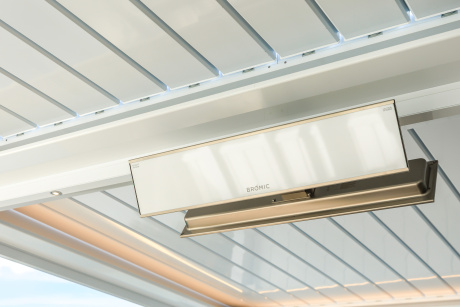
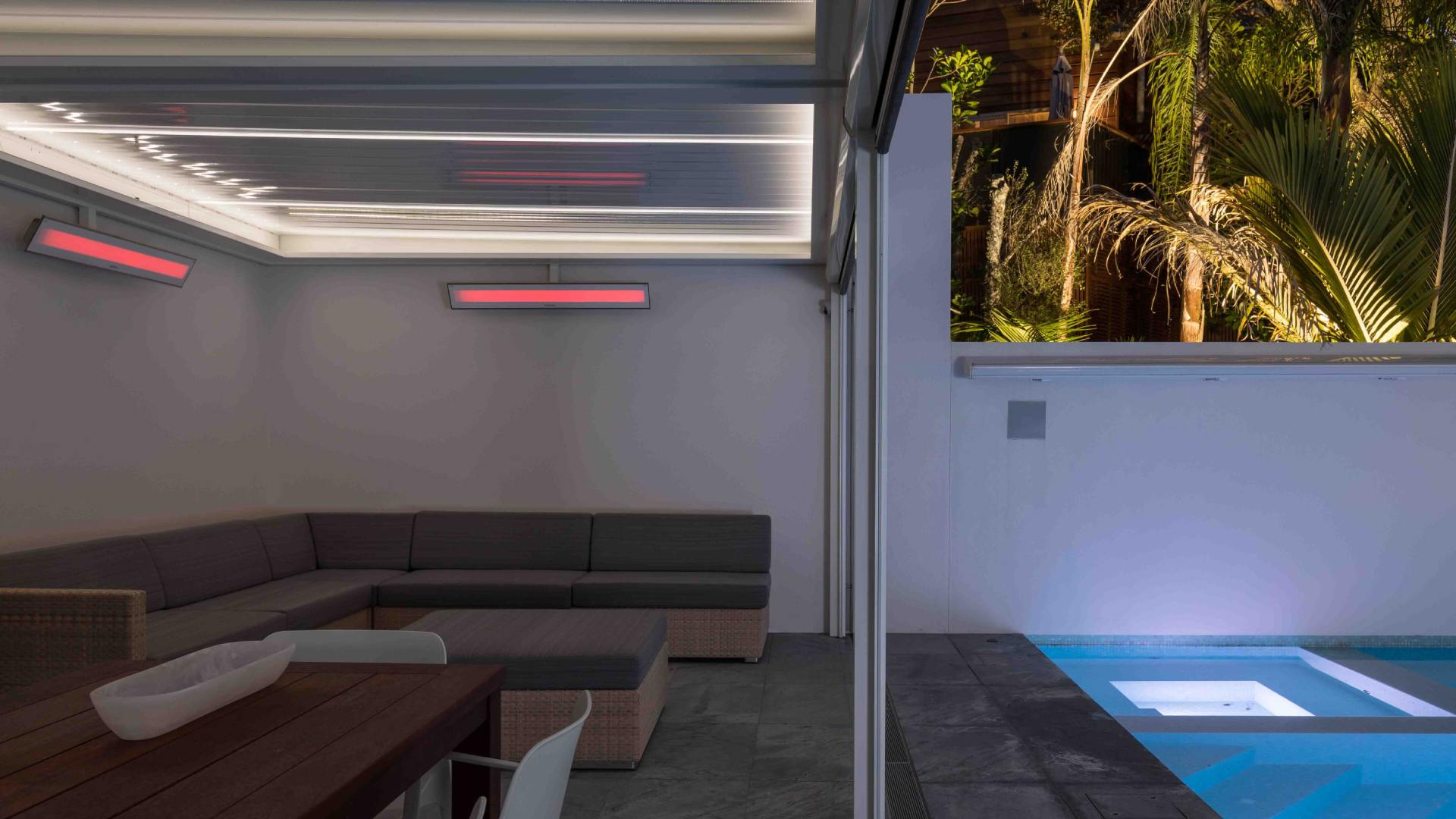
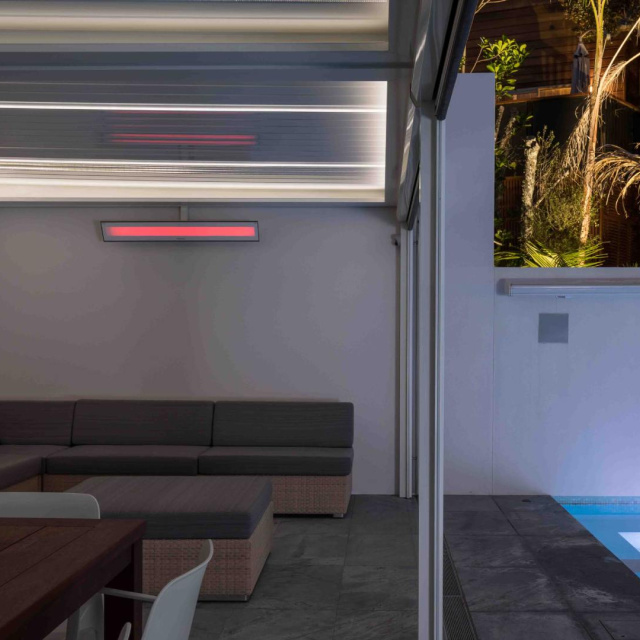
Louvretec recommends Bromic Platinum and Eclipse Electric Heaters, as these heaters heat objects such as people, keeping you comfortable.
Outdoor Heater Mounting Styles
Freestanding Heaters
Freestanding heaters stand on their own base and can be moved wherever needed, suiting spaces still being laid out, rental properties, or anywhere flexibility matters more than a fixed look.
Wall-Mounted Heaters
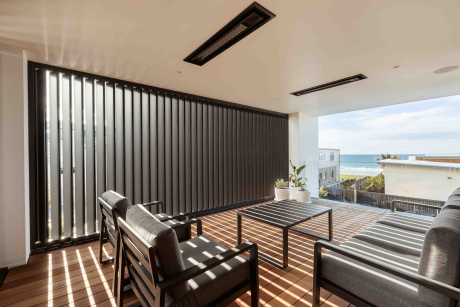
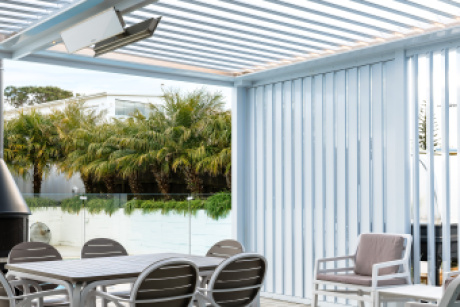
These are affixed to a post or wall, freeing up floor space for tables and chairs, and work well paired with frameless glass infill since the heater sits within the same structure as the glass rather than competing with it. Bromic Heaters can be wall-mounted.
Ceiling-Mounted Heaters
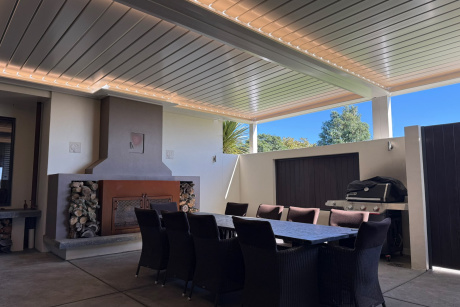
Fixed to the underside of a roof or eave, ceiling-mounted heaters direct heat straight down over the seating below with no floor or wall footprint at all. That's usually the natural fit for a Louvretec Room; the roof structure's already there to mount to, so the heater becomes part of the system rather than an extra fixture bolted on afterwards, much like outdoor lighting integrated into the same structure. Bromic heaters can be ceiling-mounted.
In most projects, mounting style follows the roof and infill decision. Get your roof in place and choose your outdoor heater system.
How to Choose an Outdoor Heater
Choosing the right outdoor heater comes down to asking yourself these practical questions:
- What is the size of the area? A small tabletop unit might cover a two-person table, but a larger alfresco or dining terrace needs either a more powerful heater or more than one, positioned to avoid cold spots.
- Is the space open, partly covered, or fully enclosed? Gas heaters need ventilation, so an open patio suits them well, while a closed-in area under a roof and glass infill generally calls for electric. If a gas line or power circuit doesn't exist yet, factor that cost in alongside the heater itself.
- What is your budget? Electric can be more economical at a small scale, while gas tends to work out more efficiently for larger, open areas needing serious heat output.
What the best outdoor heater for your space is depends on the site, how the space gets used, and what's realistic to install. A beachside café with an open deck has different needs to a suburban home with a covered alfresco and glass sides.
If the space is closed in with a roof or glass infill, electric is the safer, code-friendly choice. For a closed-in space, Louvretec recommends Bromic Platinum and Eclipse Electric Heaters. They come in wall, ceiling, and freestanding options, so they mount straight into your Opening Roof setup rather than sitting as an add-on.
Speak to your local Louvretec team about a heater suited to the specific project, not a generic recommendation.
Frequently Asked Questions
Can I use a gas heater under a closed opening roof?
It absolutely depends on ventilation. A fully enclosed space with the roof and infill closed usually is not suitable for gas, which is why electric is a great choice for closed-in areas.
Can you have an outdoor heater under a retractable roof?
Yes, as long as the heater matches how closed-in the space gets. With the retractable roof shut and any infill in place, electric is the safer option since it doesn’t need the airflow a gas heater relies on to vent safely.
Do electric heaters cost more to run than gas?
Not usually, at least not for smaller spaces. Electric tends to be cheaper per unit, though gas can work out more cost-effective for larger, open areas since fewer units are needed.
Is a ceiling-mounted heater better than a freestanding one?
Neither is universally better; they suit different situations. A ceiling-mounted unit fits naturally into a roof structure that's already in place, while a freestanding unit offers flexibility if the layout isn't fixed yet.
How many heaters does a typical alfresco area need?
That depends on the size of the space and each heater's coverage. A small courtyard might only need one, while a larger dining terrace usually needs more than one to avoid cold spots at the edges.
Ready to Choose the Right Outdoor Heater for Your Space?
Getting the type of outdoor heater right starts with the roof and infill plan already in place, or being planned. Explore Louvretec’s range, or call 1300 771 902 to talk through heating and comfort options suited to your project.