Bifold doors vs sliding doors: they both look similar in a brochure, but the way they operate and how well they suit a tight layout are very different, and picking the wrong one means living with the trade-off every day.
Learn how bifold doors, sliding doors, and hinged doors actually work, where each one earns its keep, and how to match the right option to your space.
Key Differences At a Glance
| Feature | Bifold Doors | Sliding Doors | Hinged Doors |
|---|---|---|---|
| How it opens | Panels fold and stack to one side on a track | Louvre panels glide horizontally, past or behind each other | Swings open on hinges, single direction |
| Maximum opening | Up to the full width of the opening | Around half the opening (one panel stays fixed) | Limited to the width of one panel |
| Sightlines when closed | More visible frames and panel joints | Less vertical frames | Simple single frame |
| Floor space needed | Requires stacking space to one side | Needs clear wall space to glide across | Needs swing clearance into the room |
| Locking points | Multiple, at each panel/hinge | Usually one, at the meeting stile | One, at the frame edge |
| Best suited for | Wide openings, full connection to an outdoor space | Tight layouts, narrow openings, furniture-heavy walls | Small openings, single-use doorways |
| Typical cost position | Higher, more panels and hardware | Mid-range | Lowest |
Can Bifold and Sliding Doors be Used Interchangeably for the Same Opening?
No, not without some reworking. The two systems handle the same opening in different ways, so swapping one for the other usually means more than just ordering a new door. It helps to look at how bifold doors operate compared to sliding doors, since the difference in mechanism is exactly why one can’t simply take the other’s place.
Bifold doors need stacking space at one end of the opening for the folded panels to sit. Sliding Louvre doors need a clear run of wall for the panel to glide across, plus a track that can carry the weight of larger glass panels moving horizontally rather than folding.
The header and floor tracks are built for one system or the other. A bifold track is set up for multiple smaller panels pivoting on hinges. A sliding track carries fewer, larger panels on rollers. Put a Louvre or Slidetec Glass sliding door into a bifold-prepped opening (or the other way round), and you're often looking at new tracks, a different header detail, and sometimes changes to the opening itself.
Then there's the opening's structural tolerance. Door and window openings are built to a specific size and load rating for the system going in, referenced against the relevant AS/NZS standards. Changing door type after the fact means checking that the existing opening still meets those requirements, not just measuring the width.
If you're still deciding between the two, it's far easier to settle on bifold or sliding before the opening is built than to convert one to the other later.
Which Door Type Is Better for Small Spaces or Tight Layouts?
If floor space and clearance are the main constraints, sliding doors can be the better call.
Sliding Doors Win on Floor Space
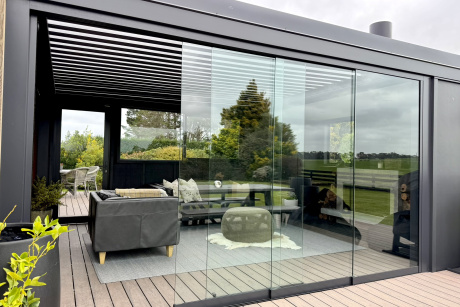
Sliding doors glide along a track without swinging into the room or needing stacking space at the end. This makes them a solid fit for narrow patios, tight alfresco areas, or any layout where furniture sits close to the opening.
If you're still narrowing down your options, our guide on how to choose the perfect sliding glass door or perfect Louvre Shutter Door walks through the details worth checking before you commit. You get a clean, space-efficient result without giving up much usable room.
Bifold Doors Provide Extra Access
Bifold Louvre doors need a bit more room to work, since the folded panels have to stack somewhere. But if the layout has that space to spare, bifold doors are worth considering for the extra access they give. Opening the whole wall rather than half of it makes a real difference in hospitality settings or larger living areas where full connection to the outdoor space matters more than saving a few hundred millimetres of floor space.
Hinged Doors Suit Smaller Single Openings
For smaller single openings, like a side or narrow entry, a hinged door can be a simple solution. It’s the lowest-cost option and doesn’t need a track system at all, but it only opens as wide as one panel, so it’s not the choice for a full wall opening.
There’s no single “best” door type. Which door type is better for small spaces or tight layouts really comes down to how much clearance the space actually has, and how much of the opening needs to be usable at once.
How to Choose the Best Louvre Doors
Choosing the right door type comes down to a handful of practical factors rather than personal preference alone. Ask yourself the following questions:
- How wide is the opening, and is there room to stack panels to one side (bifold) or clear wall space for a panel to glide across (sliding)?
- Does the layout have swing or stacking clearance without crowding furniture, walkways, or seating?
- Is the door sitting under an opening roof system? If so, does it complement the roof's airflow and shade control, or crowd the sightlines the roof is designed to create?
- How exposed is the site to wind and weather? Has the opening been assessed against the relevant AS/NZS standards for that exposure?
- Do you need the full opening usable at once (bifold), or is saving floor space the priority (sliding)?
- Is this a single, smaller opening where a hinged door is the simpler, lower-cost fit?
If you’re still weighing up bifold doors vs sliding doors vs hinged doors for a project with a louvre roof, it’s worth getting the opening assessed by an expert rather than deciding from a brochure alone. Call the team to arrange a proper look at your space before you commit to either system.
Frequently Asked Questions
Do bifold doors let in more airflow?
Yes. When fully open, bifold doors expose the whole width of the opening, so they typically let in more air and light than a sliding door, which usually only clears about half the opening.
Can you retrofit sliding doors into an existing bifold opening?
Not without changes. The track, header, and stacking space are all built around one system, so retrofitting usually means replacing the track and checking the opening against the new door’s requirements.
Which door type needs the least maintenance?
Hinged doors have the fewest moving parts, so there’s less to maintain. Bifold doors need the most attention, since every hinge and roller point is a potential wear spot.
Get the Right Door for Your Opening
Bifold, sliding, and hinged doors all do the same basic job differently, and the right one comes down to your opening, your layout, and how it sits with any roof system above it.
If you're planning a project and want design ideas on which doors and shutters suit your space, get in touch with your local Louvretec dealer for a design assessment. We'll look at the actual opening and recommend a system built for your project.